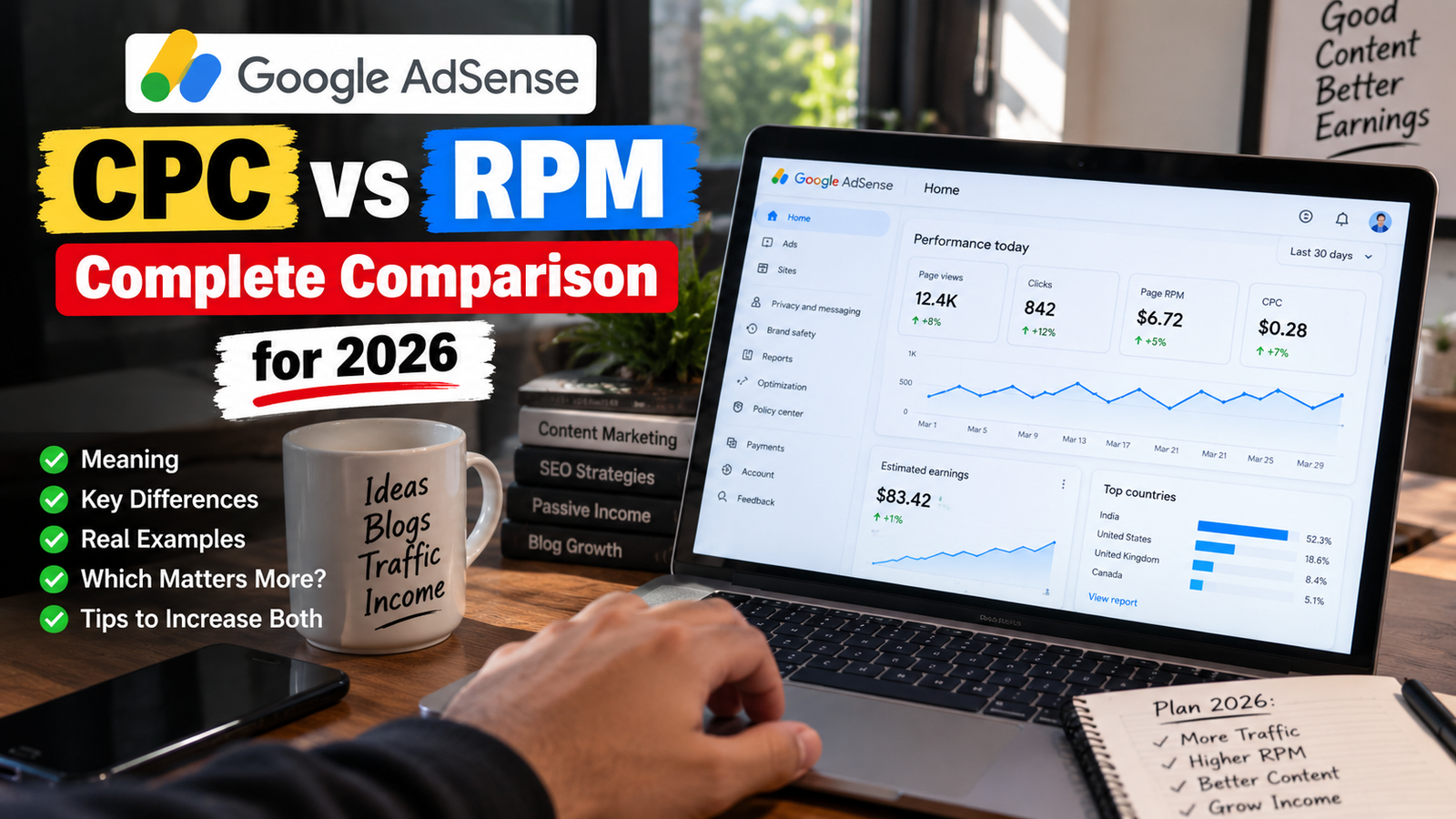
If you are making money from your website with Google AdSense, you’ve probably heard the term AdSense RPM many times. Some publishers talk about RPM going up or down, but very few explain it in a simple, practical way. In this guide, I’ll break down what AdSense RPM is, why it matters, and the exact steps you can take to increase your RPM and earn more from the same traffic.
Whether you are a new blogger, a niche site owner, or an Indian publisher trying to understand AdSense performance, this article will help you look at your earnings like a pro.
What is AdSense RPM?
AdSense RPM stands for Revenue Per Mille, which basically means the estimated earnings you make per 1,000 ad impressions. In simple words, AdSense RPM shows you how much money you earn when your ads are viewed 1,000 times.
The basic formula looks like this:
RPM = (Estimated earnings ÷ Number of ad impressions) × 1,000
For example, if your website earns ₹500 from 10,000 ad impressions, then your AdSense RPM is:
RPM = (500 ÷ 10,000) × 1,000 = ₹50
This means, on average, you earn ₹50 for every 1,000 impressions. When you understand AdSense RPM clearly, it becomes easier to find the weak points in your monetization strategy and improve them.
Why AdSense RPM is so important
Many new publishers only focus on CPC (Cost Per Click) or CTR (Click‑Through Rate). These metrics are useful, but AdSense RPM gives you a more complete picture of your earnings. RPM takes into account both clicks and impressions, and shows you how effectively your traffic is being monetized.
Here’s why AdSense RPM is important:
-
It tells you how much money you are generating from each 1,000 views.
-
It helps you compare performance across different pages, devices, and countries.
-
It allows you to test layouts, ad placements, and content types and quickly see what works best.
If your traffic is increasing but your AdSense RPM is dropping, it means you’re not monetizing your audience properly. The goal of every publisher should be to grow traffic and keep AdSense RPM healthy.
Key factors that affect AdSense RPM
Before trying to increase AdSense RPM, you must understand which factors influence it. Some of the most important ones are:
-
Niche and topics
Finance, insurance, technology, and B2B content usually have higher CPC and therefore higher AdSense RPM. Low‑intent topics like free jokes or generic news can have lower RPM. -
Traffic quality and geography
Traffic from Tier‑1 countries (like USA, UK, Canada) often earns more than traffic from low‑income regions. Returning visitors and engaged users tend to click more relevant ads. -
Ad placement and viewability
Ads that appear above the fold, within the content, and in highly visible areas generally improve RPM because more people actually see them. -
Device type and layout
Mobile traffic behaves differently from desktop traffic. A responsive layout and mobile‑friendly ad placements are essential for a strong AdSense RPM. -
Page speed and user experience
Slow pages, intrusive ads, or bad UX can reduce engagement, increase bounce rate, and ultimately lead to lower RPM.
When you know which variables affect AdSense RPM, you can quickly identify where you need to make changes.
10 Proven ways to increase AdSense RPM
Now let’s move to the most important part: how to actually increase AdSense RPM and earn more from your website. Here are 10 practical strategies you can start applying right away.
-
Target high‑value niches and keywords
If most of your content is in low‑CPC topics, your AdSense RPM will naturally stay low. Start researching high‑value niches like personal finance, insurance, investing, business tools, and web hosting. Include these topics as separate categories or at least dedicate some portion of your content strategy to them. -
Improve ad placement and viewability
Place ads where users are most likely to see them without feeling annoyed. Common high‑performing placements are:-
An ad unit after the first or second paragraph.
-
In‑content ads in the middle of long articles.
-
An ad near the conclusion or just above the comments section.
Make sure your layout is clean and responsive so that these units are visible on both mobile and desktop.
-
-
Use responsive and recommended ad formats
Always choose responsive ad units so they adjust to different screen sizes. Experiment with display ads, in‑article ads, in‑feed ads, and anchor ads. Sometimes, changing a single unit from a small banner to a responsive display ad can boost AdSense RPM significantly. -
Improve content depth and engagement
Short, thin articles rarely perform well. Aim for useful, detailed content with practical examples, step‑by‑step guides, and FAQs. Longer sessions and higher engagement often lead to more ad impressions and better RPM. Try to aim for 1200+ words for important guides, just like this AdSense RPM article. -
Optimize page speed and Core Web Vitals
Use tools like PageSpeed Insights or Lighthouse to check your site’s performance. Improve loading speed by compressing images, minifying CSS/JS, and using good hosting. Faster sites create better user experiences and can indirectly improve AdSense RPM. -
Segment and analyze your traffic
Check your AdSense and Analytics reports to see which pages, countries, and devices have the best RPM. Once you find high‑RPM segments, create more content tailored to those audiences. For example, if your AdSense RPM is higher for USA traffic on finance articles, double down on that combination. -
Avoid policy issues and invalid clicks
Any policy violation or pattern of invalid clicks can hurt ad serving and revenue. Always follow Google’s guidelines, avoid misleading clickable elements near ads, and never encourage users to click ads. Clean, compliant traffic keeps your AdSense RPM stable and safe. -
Improve internal linking and session duration
Smart internal linking keeps users on your site longer, which increases total ad impressions per session. Link related articles under each post, use “Further reading” sections, and create content clusters around important topics like AdSense RPM, CPC, SEO, and blogging. -
Experiment with Auto Ads carefully
Auto Ads can help optimise ad placement automatically, but sometimes they can be too aggressive. Test Auto Ads on a portion of your site and compare RPM before and after. If it boosts AdSense RPM without hurting UX, keep it. Otherwise, go back to manual placements. -
Regularly test and refine your strategy
The biggest mistake publishers make is “set and forget.” AdSense RPM depends on market conditions, advertiser budgets, seasons, and user behaviour. Review your RPM at least once a month, perform small layout tests, and keep adapting to what works best.
Final thoughts on AdSense RPM
AdSense RPM is not just a number in your dashboard; it’s a powerful indicator of how efficiently your website is turning impressions into revenue. When you understand what AdSense RPM means, track it properly, and apply the strategies above, you can increase your earnings even without massive traffic growth.
Focus on high‑value niches, user‑friendly layouts, quality content, and continuous testing. Over time, you’ll not only see your AdSense RPM improve, but you’ll also build a more sustainable and profitable online business.
If you’re serious about improving AdSense RPM, start by checking your current RPM for top pages today, note down your baseline, and then apply at least 2–3 changes from this guide. Track the results for the next 30 days, and adjust your strategy based on real data.